An Afro Indigenous History Of The United States
An Afro Indigenous History of the United States Kyle T. Mays
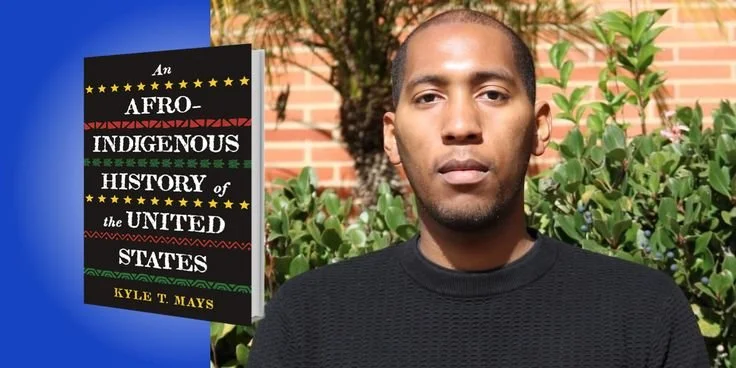
Author Kyle T Mays and his book An Afro Indigenous History of the United States
In The Afro-Indigenous History of the United States, author Kyle T Mays, an Afro-Indigenous writer and US historian uses his knowledge of urban studies, race relations, and contemporary pop culture, to explore and illustrate the history of Black American searches for freedom and American Indian history of sovereignty and dispossession and how they relate. I believe the author’s goal is to illustrate the intersections between the two groups' oppressions. Mays argues that Black and Indigenous solidarity can be possible, even though historically, relations between the two weren’t always perfect. “I want to recover some lost histories to show that Black and Indigenous histories are tied not only to enslavement and dispossession, but also a struggle for justice.” Mays includes many historical articles, writings, and perspectives from various time periods, challenging us to redefine who we consider to be Indigenous in this country and what that means. Some of the racist roots and rhetorics against Black and Indigenous people within the foundation of the US, acts of resistance, and more.
I appreciate this author’s perspective as he states his thesis to explore lesser known histories between the two groups, in order to envision and discuss what a society would look like with Black and Indigenous solidarity. What will the impacts be on Native Americans and Black Americans? “ I am only mildly interested in writing about the relationships between the five tribes and the enslaved Africans, though I'm sure that's what many will expect. The topic of enslavement and dispossession in the 19th century dominates the books on African Americans and Native Americans. However if we are to build a shared Afro-Indigenous future on stolen Indigenous land and recover the Indigenous roots of the ancestors of stolen Indigenous Africans, then it is required we find underexplored histories, rethink “accepted” histories, and survey solidarities and tensions– and also to rethink how the world might look after white supremacy and settler colonialism have been dismantled.” (Mays, Kyle) Mays aims to prove that a world where minority groups like Black Americans and Native Americans stand in solidarity, is possible, and that we must reshape the way we understand these histories in order to get there.
Mays outlines this book in 8 chapters, walking us through the presence of Afro-Indigeneity and its relations with US political histories throughout the Pre-revolutionary era, leading up to today. Mays touches on early accounts of slavery and the preservation of Indigenous identity through Black slaves within the first two chapters. Referencing Olaudah Equiano’s The Interesting Narrative of the Life of Olaudah Equiano and his recounts of his African Indigenous upbringing, culture, and lifestyles. How he, along with many other enslaved Africans didn't just “forget they were indigenous” they carried with them their indigeneity. “My goal in this chapter is to provide a few examples of these early indigenous encounters, arguing that enslaved Africans did not lose their ideas of what it meant to be Indigenous.” (Mays, Kyle).

From the Book “The Interesting Narrative of the Life of Olaudah Equiano” Written by himself, edited by Angela Constanzo
The middle chapters address forms and expressions of resistance expressed by Black and Native individuals. Mays argues that the Reconstruction period in the US “challenged deeply rooted elements of 19th century political culture.” He highlights the ways in which Black and Indigenous people practiced resistance through everyday acts such as writing, speeches, and other forms of literature. At the beginning of the book, Mays expressed how he didnt want to focus on the enslavement of Black Americans by the Five Nations, which is already heavily discussed. He addresses this point again in chapter 3, by referencing Tiya Miles The Ties That Bind: The Story of an Afro-Cherokee Family in Slavery and Freedom (2005) “While cherokees attempted to defy US encroachment and adopt US forms of modernity, like creating a writing system for their language, and some adopting enslavement as an entrance into modernity.” He discusses how the adoption of slavery by tribes like the Cherokee was an attempt to modernize themselves and in other words, get on the good side of the dominant white cultures around them. This is not used as an excuse for the vile act of racial slavery that has been displayed throughout US history, instead it is Mays attempting to clear up common misconceptions about this, that oftentimes, wedge the divide even further, preventing the possibility of solidarity of the two groups.
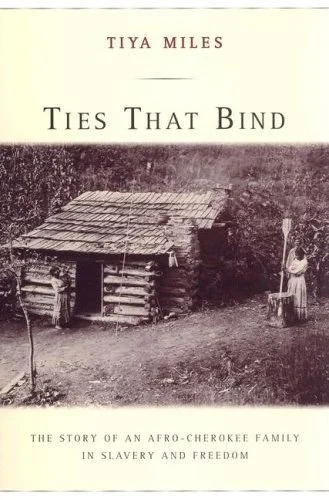
Tiya Miles, “The Ties That Bind; The Story of An Afro-Cherokee Family In Slavery and Freedom”
Mays moves on to discuss the way early advocates, such as Tecumseh have shaped the system of resistance that we now know today. “Tecumseh advocated a political and military alliance to oppose US encroachment on Indian land.” from Peter Cozzens Tecumseh and the Prophet (2020). Mays addresses how the Treaty of Paris in 1783 formally ended the Revolutionary War between the US and the British, but created further issues with tribal nations like the Shawnee. It was the Treaty of Greenville (1795) that created the largest issue by having 99 chiefs sign a treaty that gave up all of their land except Ohio. Tecumseh never signed the treaty and the Shawnees were excluded from it. He asked tribes to join him and the Shawnee in Prophetstown (Lafayette, Indiana). In the summers of 1807 and 1808, Tecumseh and the Shawnees were joined by Delawares, Ottawas, and Chippewas, Potawatomis, Kickapoos, Miamis. Sacs, and Wyandots
Tecumseh fought to form a confederacy of Indigenous Nations to challenge the US encroachment on Indigenous land. Roxanne Dunbar Ortiz writes of Tecumseh “His program, strategy, and philosophy mark the beginning of pan-indigenous movements that established a foundation for future resistance.” The Progressive Era is also discussed and how forms of resistance by Black Americans were often met with violence. Mays quotes historian Rayford Logan “The plight of the Negro worsened precisely because of the efforts made to improve it.”
Native Americans also suffered deeply during the Progressive Era. Natives lost treaties with the US, were displaced even more, and couldn’t even govern their own community affairs without the US govts say so during the Progressive Era (1890s-1920s) Although the two groups were met with more violence, oppression, and outright hatred post abolition, they continued to find ways to organize, protest, and resist the oppressive ways of the settler colonialist society they had been suffering under.

“Tecumseh And The Prophet; The Shawnee Brothers Who Defied A Nation” By Peter Cozzens
The later half of the book moves into more modern examples of unity, protest, and solidarity. In Chapter 6: Black Power and Red Powers, Freedom and Sovereignty, Mays discusses how third world oppression also operated in the US, and in turn has created a common ground for most minority groups in the US. “For the third world peoples have a common history of dehumanization and oppression based on race. This is what binds Afro-Americans, Mexican-Americans, Asian Americans, and Native Americans to their ancestors and relatives in distant lands. Native Americans found their lands ruthlessly stolen and themselves decimated by enslavement and European diseases. Millions upon millions of Africans were torn from their villages, tossed into slave vessels, and transported thousands of miles to be forced to labor in mines and on plantations in the “New World”.” The two groups recognize the common oppressions they share, and how one group cannot be truly free while the oppression of the other continues. From this outrage emerged “Radical ethnic nationalism” (Mays,Kyle) forging Black, and Native American coalitions. “They viewed their movements separately, but what brought them together in protest and ideological struggle was a complete overturning of the capitalist, settler-colonial, and white supremacist system that had kept them oppressed for centuries” (Mays, Kyle).Natives protested in similar ways to Black Americans. Through sit ins, fish-ins, and creating rebellions. The groups also overlapped ideologically. The AIM (American Indian Movement) borrowed from the Black Panther party, studied them and worked with them. Discourse around “Black power” inspired the term and ideas behind “Red power”. An embrace of one’s Black and Native roots, cultures, and histories despite the efforts of erasure from White society.
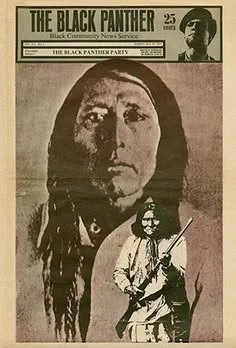
Cover of the Black Panther Community News Service
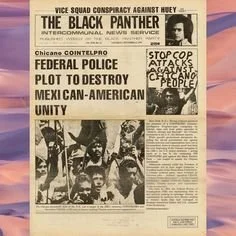
The Black Panther Community News Service coverage on Chicano alliance conflicts with police
Deloria Jr, a Standing Rock Sioux is referenced, as they understood the power of Black rhetoric for others, and believed the Black Power movement resonated for Indians because it was based upon the language of power and sovereignty. We continue to see the rise in solidarity between Black and Native Americans very heavily through the Civil Rights Movement in the 1960’s and 1970’s. Black and Indigenous people participated in each other’s protests. They showed up to each other's rallies, including the takeover of the Bureau of Indian Affairs in 1972, and the occupation of Wounded Knee in 1973. Pan-africanist Stokely Carmichael showed up during the third day of the takeover of the Bureau of Indian Affairs where natives stormed the office, and took important documents related to tribal issues. “This land is their land, there can be no settlement until their land is returned to them”. To my appreciation, Mays provides photographs and historical information of several Black Activists and Native American Activists working together, and showing up for one another ( Nelson Mandela with Clyde Bellecourt, Angela Davis with Oren Lyons, an Onondaga chief from Nedrow NY after the Wounded Knee trials in 1973, and an audience of Black, Indigenous, and White supporters at a rally in support of Dennis Banks and Russell Means at the Wounded Knee trials 1974).
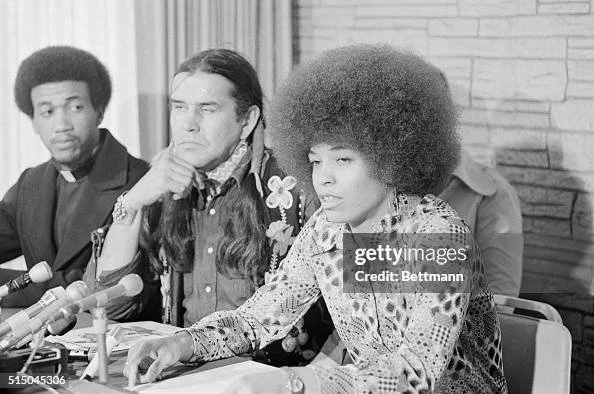
Angela Davis, Clyde Bellecourt and Rev. Ben Chaviz at Chicago confrence. May 11, 1973
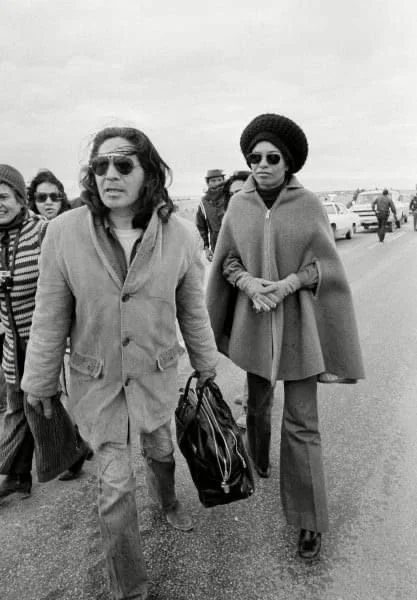
Oren Lyons and Angela Davis alongside each other at the Occupation of Wounded Knee, South Dakota,1973
The last two chapters focus on modern day interactions between Black Americans and Native Americans through social media, the discussions that are being had in these spaces, including the ideas of Cultural Appropriation and Cultural Appreciation. “Cultural appropriation in Black and Indigenous contexts can be defined in terms of minstrelsy and “playing Indian” we also call them blackface, and red face”. “Playing indian” is a new term to me, but not the idea of it entirely. This happens in the form of non-indigenous people wearing headdresses, utilizing indigenous patterns in the fashion world, or sports mascots. “Playing Indian is an attempt to keep Indigenous peoples and their customs stuck in the past in order to take their land”(Mays, Kyle). In similarity, minstrelsy is demonstrated through black face, and/or the use of Black American english, and slang. These are two things that have been the topic of discussion for a while on Social media, as our awareness of these issues begins to expand. More and more of us are calling it out for what it is. Wrong. I appreciate May’s inclusion of these topics to wrap things up and bring the history discussed into today’s societal atmosphere.
Kyle T Mays, as an Afro-Indigenous scholar, and person, resonates a lot with me, and some of the ideas and feelings I've had while studying Native American history. I am a Black (racially) and Latino (ethnically) woman, who has been recently reconnecting with the Indigenous roots which I come from, so to see someone like me, be respected, and knowledgeable in both identities is very refreshing. I believe it is important that discussions around intersectionality continue to be had, as we come closer and closer to a society that understands its history and is willing to dismantle and create something better. A lot of us have intersecting identities, so in order to fully understand how to show up for one another, we must address the good, the bad, and the ugly to say the least. Mays has incorporated a lot of the information we go over in class, into the arguments being made. He integrates it in a way that makes sense to the progression of this relationship between Black and Indigenous communities, and how we understand Native American history in general. This book gives me a different perspective on Native American history, and allows me to see myself, my family, and my loved ones in it. Therefore making it even more impactful and important to me. I usually never see myself in history, and when I do, it's never through a celebratory lens. But Mays, even through outlining the ugly rhetoric held by many, highlights the beauty and accomplishments made, and allows us to envision the possibilities through the embrace of two cultures, bound by the same oppressions, freed by their unity.
Bibliography
Carmichael, Stokley and Hamilton,Charles, Black Power: The Politics of Liberation (New York: Vintage Press 1992)
Cozzen, Peter, Tecumseh and the Prophet: The Shawnee Brothers Who Defied a Nation (2020)
Logan,Rayford W. The Negro In American Life and Thought: The Nadir 1877-1901 (New York: Dial press 1954)
Mays,Kyle T. An Afro-Indigenous History of the United States (Boston: Beacon Press, 2021)
Miles, Tiya, The Ties That Bind: The Story of an Afro-Cherokee Family in Slavery and Freedom (California, University of California, 2005)
Ortiz, Roxanne Dunbar, An Indigenous People’s History of the United States (Boston, Beacon Press 2014)