Introduction On “The Conjuring Of America: Mojos, Mermaids, Medicine, and 400 Years of Black Women’s Magic” By Lindsey Stewart
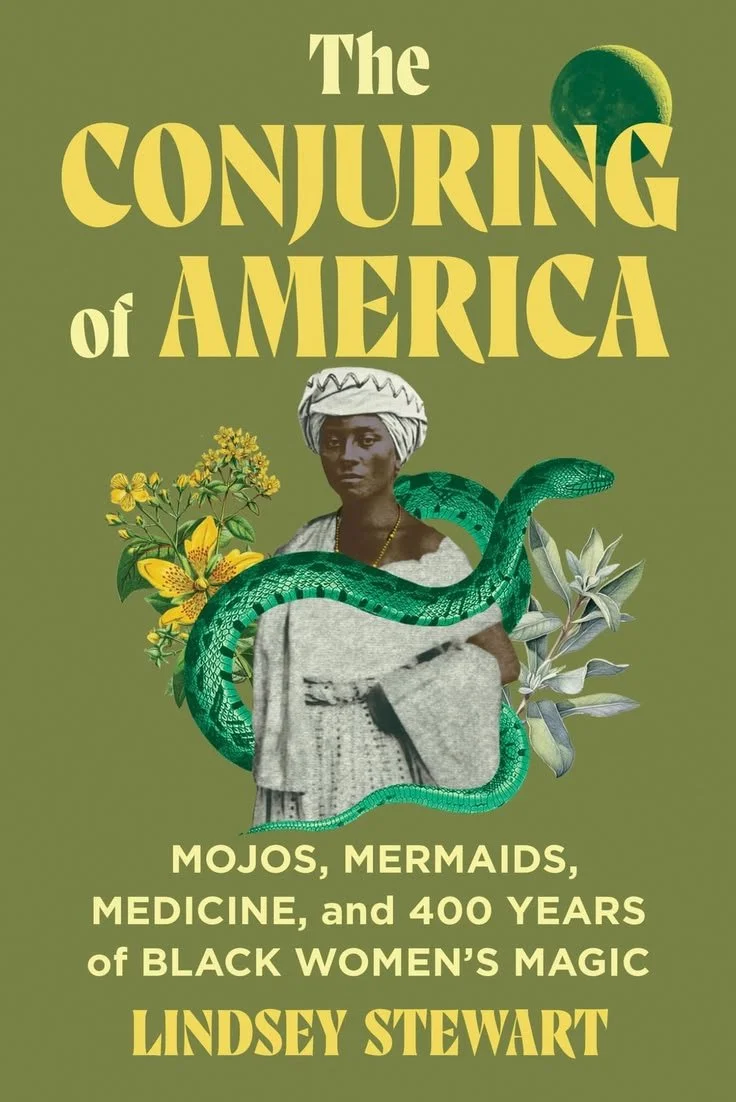
The Conjuring of America: Mojos, Mermaids, Medicine, Medicine and 400 Years of Black Women’s Magic
By Lindsey Stewart
The conjuring of America; Mojos, Mermaids, Medicine and 400 Years of Black Women’s Magic by Lindsey Stewart is a narrative on the influence of Black Women throughout the history of the US. Exploring themes like magic, folklore, African spirituality, and African American Hoodoo, alongside historical accounts of the origins of modern day medicine, music, and American culture. Stewart uses history and culture to not only empower Black women, and Black readers but also to educate the reader on histories that have not been made accessible to the general public (intentionally so). This is not your basic insight on the hidden Black origins of the lightbulb,or the streetlight, or peanut butter (although these were creations invented by African American people) no. Stewart’s writing transports readers through time, and brings a sense of insight on the harvesting of indigo and how that has influenced the popularity of blue jeans. Black women’s relations to mermaids through orisha stories based on Oshun and Yemoja. She even touches on the importance of roles Black women have held in the community for years like as the hairdresser, or the neighborhood candy lady. The power these positions hold and where they come from (More on this in Part One).
Introduction: How To Keep That Shit Off You
“For as long as Black Women have been in the US, we have used our magic to battle the racism and sexism that plagues our lives. We have used our magic to identify and commune with one another and to build a world where we are valued and seen.”
It is no secret that Black Women are plagued with the weight of carrying intersectional identities in a culture that is so very racialized and gendered. In a culture like this, survival becomes an instinct. I think of Audre Lorde’s quote on this in a 1985 interview, “Survival is not theoretical when living on the edge of any structure. For a Black woman, and for a Lesbian, survival becomes very real when one is conscious that their identity is on the edge. Living on that level of survival as a reality teaches one to value and critique the particulars all the time because anything can mean the end at any moment, which provides a kind of sharpness” (2). Black people in general exist on the edge of the structures of white capitalism and Black women, Black Lesbian women, Black Transwomen, and Black queer identities alike feel this sharpness Lorde mentions very deeply. This feeling that everything can be taken from you or can end at any moment as a result. And as a result of this reality, survival has never been negotiable. Therefore making our magic and ancestral practices all the more necessary and powerful.
#Blackgirlmagic
You may have seen this tag be used within the past decade by your Black woman friends, family, or influencers and celebrities when sharing a beautiful image of oneself, or others doing something magical or whimsy. This phrase was coined by Joan Morgan, author of “When Chickenheads Come Home to Roost” (If you don’t know what a chickenhead is, please exit the chat) a title in which I absolutely need to check out! Based on the title alone, I know Imma enjoy that. When coining the term BlackGirlMagic, Morgan suggested that our magic stretches all the way back to West Africa. “At a time when she, like so many of us, needed to be reminded of her self worth, Morgan turned to the comfort of the sea so that she could breathe again, unafraid of her tears or fragility.” (Stewart 2) Moving us into some of the most impactful oral stories of Yoruba Orisha Oshun. I will definitely get into that here soon, but first, I have to relate this to my time in Puerto Rico this past summer. I spent my 25th birthday on Condado Beach, Puerto Rico on my second solo trip ever. My first solo trip was to the glorious city of New Orleans (more on that later) and after that experience, I was hooked. Solo travel is where it's at for Black women! (with standard precautions of course) always putting others' comforts and needs before our own. It's nice to be somewhere new with no expectation on what you should or shouldn’t be doing with your time. If you grew up anything like me, this was never even something I thought could be a possibility. Riddled by the fear and anxiety of the world passed down to me from my parents, and their parents, and so on, I always dreamed of seeing the ocean one day. That day came August 1st 2026 (yes I’m Leo!) on the most beautiful island I'd ever laid my eyes upon, and I ain't been the same since. So yes, the healing power of the water called in by Oshun and Yemoja is so real for a Black girl like me.
Stewart goes on to mention Oshun and her origins and association with the ocean. “Oshun belongs to the pantheon of gods called orishas in Yoruba religion. Ruler over the rivers that carve up continents and the tiny torrents of blood, streaming through our bodies. Fierce warrior, protector of women, mother of abundance, called upon when love and money and wombs run dry, mirror that lets women see themselves as worthy of every good thing in life, symbol of black girl magic” (Stewart 2). Oshun came to me to show me exactly this. To be a mirror that reflected myself back at me. Through her fierce femininity, balanced with divinity and sweetness of honey, the inner recipe every Black woman holds.
“There’s an old Yoruba tale about Oshun that explains how Black women and girls got their magic. It begins with an important question: what would happen if all the women in the world vanished?” (Stewart 3)
Stewart goes on to tell the tale of the Orisha Oshun pulling herself and her power back as a result of her brother Orisha's scheming against her. They underestimated and undervalued her impact on the world, and were left to feel the impacts of her void as they planned to give men ultimate power over women. Of course, they began to mistreat and abuse them, resulting in Oshun removing all the women from the earth. “She understood that sometimes the only way to show someone how much you’re needed is to remove your presence” (Stewart 4)
The men went cold and hungry, suffering from the imbalance, facing the loss of new human life. With no new human life, the men could no longer envision a future. The brother orisha complained to Olodumare (The supreme God in Yoruba religion) and Oshun heard their cries. However, she knew their nature. She knew that they would ultimately continue to try and over exert their power to suppress women. So Mama Oshun, embedded a piece of her own power in the hearts of these women. “The same power used to create the universe– a power called aje or magic” (Stewart 5) These special women have been known as iyami aje in Yoruba, translating roughly to “my mysterious mother.” Witches, healers, mothers, herbalists, medicine women “The Iyami aje played a vital role in the community. They were believed to be powerful women who held the health of the community in their very hands. Through their vast knowledge of herbs, they corrected the imbalances that brought about illnesses. And they used their power to balance their social world against oppression.” (Stewart 6)
Alright now, after coming back to this writing after a few days, I realize I have to be very careful with what information I choose to include here, and what needs to be left out. What needs to be protected and kept sacred. But I also know if it weren't for other practitioners online sharing some of their learnings with us all, I wouldn’t be here before you now. It’s a delicate dance us practitioners today are learning to navigate as we would love to educate other Black African American folk online who, like me, may have been left in the dark about all this as a very intentionally laid result of colonialism and indoctrination. However, some things truly are sacred and meant to be kept that way, so bear with me.
So what is Hoodoo? What is conjure? I’ve referenced some of Stewart’s accounts on the African origins of these beliefs and practices. But African American Hoodoo is its own thing entirely. A culmination of practices from the motherland, shielded under the guise of christianity as a result of enslavement and indoctrination. And probably, one of my favorite aspects of Hoodoo, the influence of Native American practices enmeshed as well. As a Black Indigenous woman, Hoodoo damn near fell right into my lap. My ancestral birthright. You don’t have to be Black and Indigenous to practice (although a lot of us are) but the fact that there are foundations laid out for me already, over generations and generations of sacred knowledge and practice from my African, African American, and Native American (Dine or Navajo) ancestors is so perfect. You can find practices like this in various countries with African influence and history of chattel slavery like Haitian or Creole Voodoo practiced in New Orleans (again, it’s own thing), Santeria practiced in several Latin American and Caribbean countries, and so on. An enmeshment of practices and beliefs forged from the enslaved carrying their indigeneity with them across oceans, intertwining their interactions with the indigenous people of whatever land they were forced onto. Disguised by the abrahamic religions of their enslavers. All in the spirit of survival. “Enslaved Africans carried their knowledge of herbs, medicine, and relationship to the divine with them, emerging into new spiritual practices with old african roots like Haitian Vodou, Jamaican Obeah, Brazilian Candomble, Cuban Santeria, and Conjure and Hoodoo”
Stewart goes on to explain how and why conjure women throughout slavery worked under such harsh conditions. “Conjure women were believed to be especially skilled in treating an abundance of mishaps that, left unmanaged, could greatly increase the misery of the enslaved.
Conjure women had this incredible range because they saw the social suffering and physical ailments of those under their care as intimately linked. So the conjure women’s treatment of your ailments included not only methods to remedy your physical pain but also an assessment of the social imbalance that made you susceptible to that illness in the first place.Conjure reminds us that even when things are most dire, it's possible to drum up power in unexpected places. To learn the history of conjure women is to learn something vital about ourselves at a time when we need it most: we are not powerless.”
To be continued…
Citations
Stewart, Lindsey, and Adenrele Ojo. The Conjuring of America: Mojos, Mermaids, Medicine, and 400 Years of Black Women’s Magic. Legacy Lit, 2025.
2. Lorde, Audre, Law Center, Transgender. “72k Views · 3.5K Reactions: Audre Lorde Taught Us That Survival Is Not Silent. It’s Spoken, Insisted upon, Named out Loud, Even When Fear Tells Us Otherwise. in a 1985 Interview, She Reminded Us: ‘When We Speak We Are Afraid Our Words Will Not Be Heard or Welcomed. but When We Are Silent, We Are Still Afraid. so It Is Better to Speak.’ Today We Honor Lorde, a Black Woman, Lesbian, Mother, Leader, Poet, Whose Work Reshaped Feminist Thought, Queer Liberation, and the Fight against Racism, Sexism, Classism, Ableism, and Homophobia. as a Member of the Combahee River Collective and the Author of Sister Outsider, She Demanded That Movements Confront the Realities of Black Women and Queer Women at Their Center. Her Legacy Lives on through the Audre Lorde Project @audrelordeproject and in Every Trans, Nonbinary, and Queer Person Who Refuses to Be Silent as a Condition for Survival. Sources: Poetry Foundation, Audre Lorde Project: Transgender Law Center.” Facebook, 5 Dec. 2025, www.facebook.com/translawcenter/videos/audre-lorde-taught-us-that-survival-is-not-silent-its-spoken-insisted-upon-named/1967306507152443/. Accessed 19 Oct. 2026.